Swiss Pocket Watch Brands: A Sourcing Pro’s Guide to Quality Control

Sourcing top-tier swiss pocket watch brands isn't just about chasing aesthetics or a prestigious nameplate. It is a technical deep dive. In the world of high-end horology, genuine Swiss manufacturing is governed by the 60% rule—meaning at least 60% of production costs must be generated in Switzerland. For B2B buyers and brand managers, this requires a ruthless vetting of movement origins, case finishing, and assembly standards to protect your brand integrity.

Beyond the Label: Why Swiss Pocket Watch Heritage Governs Modern Sourcing
Let’s be honest: the "Swiss Made" label is the most powerful marketing tool in the watch world, but it is also a potential legal minefield. When you are sourcing for a private label or a high-stakes corporate project, understanding this heritage is not just about history—it is about pure risk management. You need to know exactly what you are paying for.
The Legal Framework of the "Swiss Made" Ordinance
The "Swissness" law is uncompromising. For a swiss made pocket watch to carry the mark, the movement must be Swiss, the movement must be cased up within Swiss borders, and the final inspection must take place there. As a sourcing professional, you have to verify that your partner is not just "assembling" a kit of imported parts but is actually hitting that 60% value threshold. If they can't show you the cost breakdown, walk away.
Horological Centers of Excellence: Le Locle, Biel, and Geneva
If your supplier operates out of Le Locle or Biel, they are sitting in the epicenter of the industry. These regions are home to a specialized micro-mechanics ecosystem that produces everything from hairsprings to balance wheels. Sourcing from these hubs is a strategic move; it ensures you have access to a deep bench of specialists if your primary factory hits a production bottleneck.
Evaluating the Residual Value of Swiss Engineering in B2B Markets
Swiss engineering is about more than just prestige—it is about long-term serviceability. A pocket watch switzerland exports today is built on standardized calibers that can be repaired 50 years from now. This longevity is a massive selling point for B2B clients who want their corporate gifts to stay in circulation as family heirlooms rather than ending up in a drawer.
Assessing Tier 1 vs. Tier 2 Swiss Manufacturers for Private Label
Historic Powerhouses: Tissot, Longines, and the Swatch Group Ecosystem
When you have the volume to back it up, working with Swatch Group icons like Tissot offers incredible stability. These giants have successfully refined the mechanical pocket watch for the 21st century. The trade-off? For private label work, these swiss pocket watch brands often demand high MOQs and offer very little wiggle room for deep, bespoke customization.
Niche Artisans and Independent Assemblers for High-End Customization
For those specialized, boutique projects, the independent workshops tucked away in the Jura Mountains are usually the better play. These "Etablisseurs" are masters of assembly. They can mix and match high-grade components—think a specific ETA movement paired with a custom-engraved case—with far more flexibility than the mass-market giants.
Identifying Reliable OEM Partners in the Jura Mountains
When you're vetting an OEM partner, ignore the fancy showroom. Demand to see the clean rooms and the pressure-testing stations. A legitimate Swiss partner will have a documented, step-by-step workflow for every stage of the assembly process. If the shop floor looks chaotic, your final product will reflect that.
Technical Benchmarks: The Anatomy of a High-Performance Movement
Mechanical Calibers vs. High-Precision Quartz Modules
The movement is what dictates your price point and your lead time. Mechanical calibers, like the legendary ETA 6497, remain the gold standard for traditionalists. They provide that iconic, soulful ticking sound. On the flip side, Swiss quartz modules offer a thinner profile and zero maintenance—perfect for modern, slimline designs that need to be practical.
Power Reserve Standards and Accuracy Tolerances in Pocket Horology
A respectable Swiss mechanical pocket watch should offer a power reserve of at least 40 to 46 hours. When it comes to accuracy, a well-regulated movement should stay within a range of -10/+15 seconds per day. If a supplier tries to tell you these tolerances aren't guaranteed, they are likely cutting corners on the final regulation process.
Complications and Sourcing Feasibility for Bespoke Projects
Adding a moon phase or a power reserve indicator looks impressive, but it complicates your supply chain. Every extra "complication" typically adds 4-6 weeks to your lead time and spikes the QC failure rate. For the vast majority of custom projects, we recommend sticking to "Time Only" or "Small Seconds" to ensure rock-solid reliability.
The Quality Control (QC) Matrix for Professional Procurement
Quality control is where 90% of sourcing projects fall apart. You need a rigorous, non-negotiable matrix to evaluate every batch.
Micro-Engineering Tolerances: Case Fit and Crystal Alignment
The "snap" of a hunter-case watch is the ultimate tell-tale sign of build quality. If that lid has even 0.5mm of wiggle, the hinges are poorly machined. Whether you choose Sapphire for high-end or Mineral for mid-tier, the crystal must be seated with a perfect seal. There is no room for error here.
Surface Finish Protocols: Mirror Polishing and Guilloché Patterns
Take a 10x loupe to the polishing. You are looking for "black polishing"—a finish so perfectly flat it appears black from certain angles. If you see "orange peel" textures or micro-scratches, the factory is rushing the buffing stage to save time.
Final Functional Testing: Hinge Durability and Dust-Resistance Seals
Remember, a pocket watch lives in a pocket—the most hostile environment imaginable for dust and lint. We insist on O-ring gaskets even for models that aren't marketed as waterproof. It is a simple step that prevents massive maintenance headaches later.
Sourcing Comparison: Mechanical Tradition vs. Modern Efficiency
| Feature | Mechanical (Manual Wind) | Swiss Quartz Movement | Automatic (Self-Winding) |
|---|---|---|---|
| Craftsmanship Level | High / Traditional | Industrial / Precise | Modern / Complex |
| Maintenance Cycle | 3-5 Years | Battery Change 2 Years | 5 Years |
| Sourcing Lead Time | 12-16 Weeks | 6-8 Weeks | 10-14 Weeks |
| Customization Depth | Skeleton Dials / Engraving | Dial Printing / Case Back | Rotor Engraving / Case Back |
| Cost Basis | Premium | Competitive | Mid-to-High |
Customization at Scale: Bridging Swiss Engineering with Personalization
At Tailsprouts, we’ve found that the best way to elevate a Swiss timepiece is through localized, precision customization that respects the base engineering.
Laser Engraving vs. Pad Printing: Achieving 0.1mm Detail
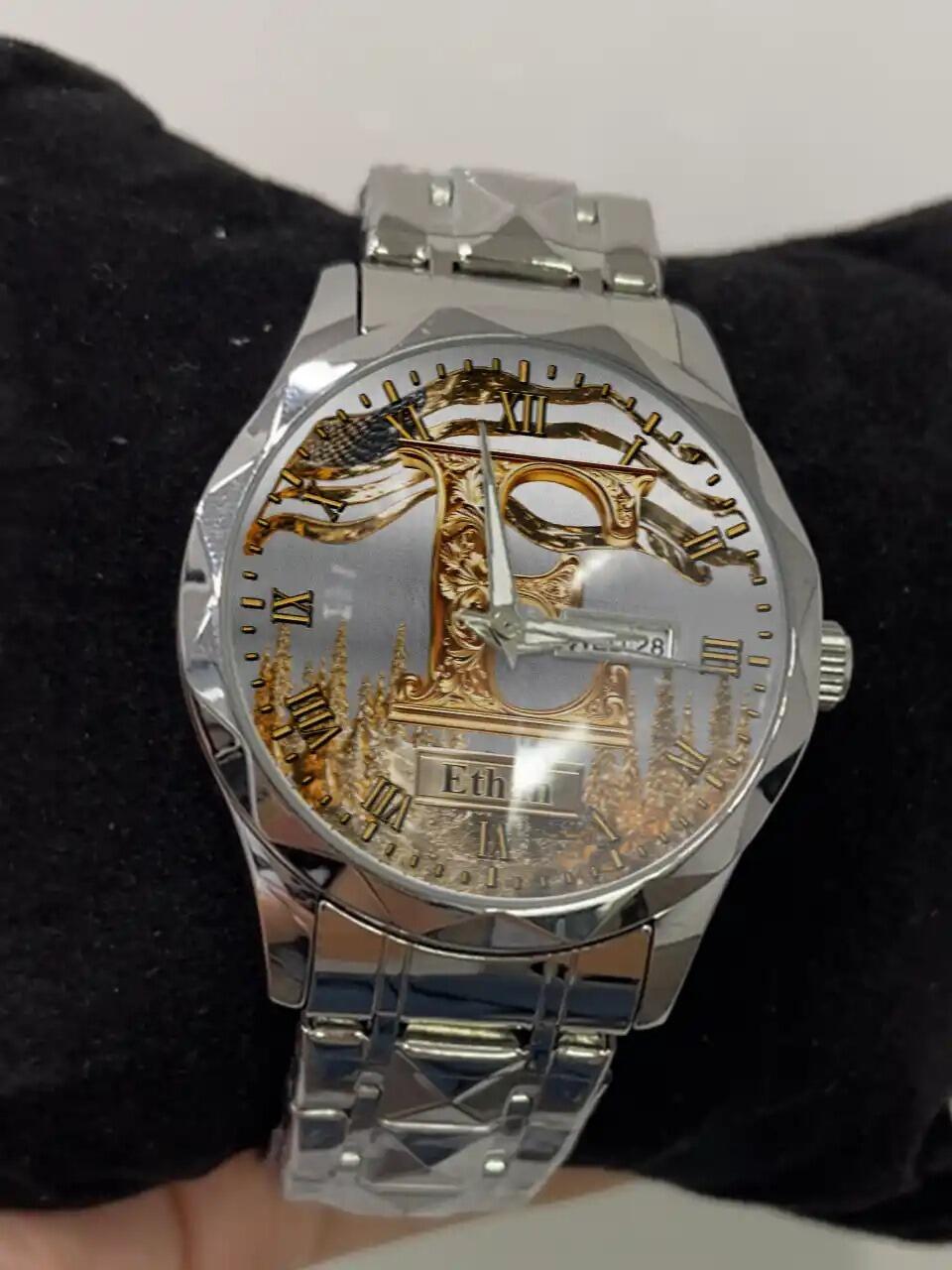
For case backs, laser engraving is our industry standard. It creates a permanent, high-contrast mark that won't fade. For dials, we use pad printing (Tampography) to achieve multi-color logos with razor-sharp edges. You can see this level of precision in our Personalized Initial Metal-look Dial Pattern Watch, which captures the look of high-end guilloché without the massive lead time.
Sourcing Bespoke Dials: From Enamel to UV Graphics
The dial is the soul of the watch. While traditional enamel is stunning, it’s also brittle and incredibly expensive. Modern UV-printing on brass allows for complex gradients and textures that look phenomenal under a domed crystal, providing a high-end feel at a manageable price point.
Material Selection: 316L Stainless Steel vs. PVD Brass
Always specify 316L Stainless Steel for the case if your budget allows. It is hypoallergenic and can be re-polished for decades. Brass is fine for promotional tiers, but only if it’s finished with high-quality PVD (Physical Vapor Deposition) coating to prevent tarnishing and wear.
Navigating the Supply Chain: Common Bottlenecks and Solutions
Managing Lead Times for Genuine Swiss Components
The Swiss watch industry moves at its own deliberate pace. Specific components like hands or custom crowns can have 12-week lead times. The pro move? Standardize your base components and focus your customization on the elements—like dials and engravings—that provide the most visual impact for the least effort.
Logistics Transparency: Duty Drawbacks and Secure Shipping
High-value timepieces require insured, armored shipping. If you are importing into the US, make sure your broker understands the specific "Watch & Clock" duty schedules. These are calculated based on movement type and jewel count, and a mistake here can be a costly surprise.
How to Vet a Factory's QC Documentation
Don't just take a salesperson's word for it. Demand the ISO 9001 audit report and a specific "Swiss Made" compliance certificate. A professional, high-output factory will have these documents ready to share in minutes, not days.
Solving the "Sourcing Headache": Common Pain Points
Addressing Inconsistent Finishing in Large Batches
When you're ordering 500+ units, the first 50 might look perfect, but unit 450 might show tool wear. We solve this by requiring "Gold Samples" from every production run and performing 100% AQL (Acceptable Quality Level) inspections before the final payment is wired.
Managing Communication with Boutique Workshops
Many boutique Swiss shops are run by master watchmakers, not account managers. Forget the long, flowery emails. Use clear, visual "Spec Sheets." A technical drawing with measurements in millimeters is a universal language that prevents expensive mistakes.
Establishing Prototype Approval Workflows
Never, ever skip the prototype phase. It is much cheaper to spend $500 and four weeks on a single sample than it is to receive 200 watches with a misspelled logo or the wrong hand color.
The Tailsprouts Standard: Selecting the Right Components
When we curate gifts for corporate clients, we focus on the tactile experience—how the watch feels in the hand.
Matching Movement Type to the Occasion
For a retirement milestone, a manual wind mechanical watch is the right choice—it requires a daily ritual that builds a bond with the object. For a high-volume sales reward, Swiss Quartz is often better because it’s "set and forget." If you need broader inspiration for these rewards, check out our guide on Top Personalized Gifts for Men.
Ensuring Longevity: Why Material Density Matters
A pocket watch should have a satisfying "heft." If it feels light, it feels cheap. We ensure our case densities provide that substantial weight that signals quality the moment it is pulled from a pocket.
The Unboxing Factor: Sourcing Premium Presentation Cases
The experience starts with the box. We recommend our Luxury Watch Box to ensure the first impression matches the Swiss engineering inside. This is vital for holidays like Father's Day, where the presentation is half the gift. For more sentimental gifting strategies, see our 10 Unique Father’s Day Gift Ideas.
![Elegant Watch Box [[{"value":"shop name"}]]](https://cdn.shopify.com/s/files/1/0628/8077/6262/files/elegantbox.jpg?v=1778632351)
Professional Sourcing FAQ
What are the best Swiss pocket watch brands for bulk B2B procurement?
Tissot, Mondaine, and Wenger are the gold standards for reliable bulk orders. For private label, look into manufacturers like Ronda or independent ETA-based assemblers in the Jura region.
How does the "Swiss Made" law impact custom-engraved components?
Engraving the case back or the dial does not strip the "Swiss Made" status, provided the core assembly and the movement still meet the strict legal requirements.
What is the typical lead time for a private-label order of Swiss pocket watches?
Plan for 12 to 24 weeks. Quartz models are generally on the faster end, while mechanical models depend heavily on movement availability from the big suppliers.
How do I verify the authenticity of a Swiss manufacturer's certification?
You can contact the Federation of the Swiss Watch Industry (FH). They maintain a comprehensive database of legitimate manufacturers and can help you verify any "Swiss Made" claims.
Can I customize the dial design while maintaining "Swiss Made" status?
Yes, as long as the dial is manufactured or printed in Switzerland, or if the overall cost of the watch still complies with the 60% Swiss value threshold.
What are the primary differences between sourcing mechanical vs. quartz pocket watches?
Mechanical watches are the premium, traditional choice but take longer to source. Quartz watches are accurate, slimmer, and much more cost-effective for large-scale corporate gifting.